Introduction
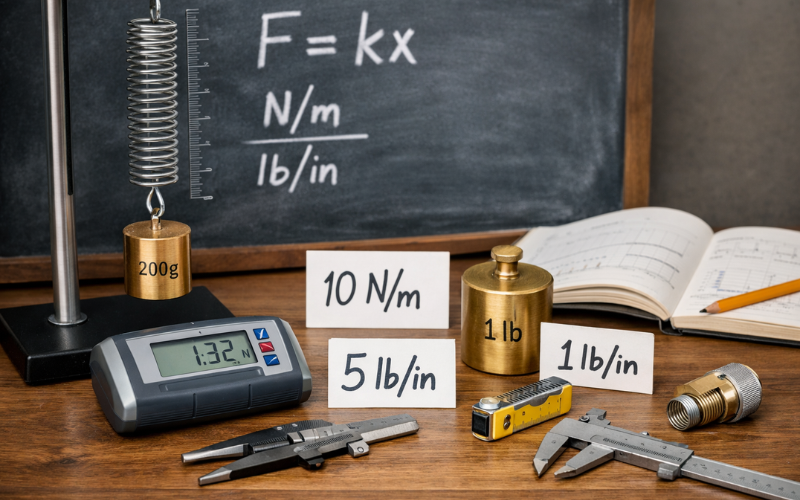
The spring constant is a value that tells us how stiff a spring is. In simple terms, it shows how much force is needed to stretch or compress a spring by a certain distance. A stiff spring needs more force to move, while a soft spring moves easily. This relationship between force, movement, and stiffness makes the spring constant an important concept in physics and engineering.
Because the spring constant connects force and displacement, its units are based on how force and distance are measured. Understanding the correct units for the spring constant is essential when solving physics problems, designing machines, or working with mechanical systems. If the wrong units are used, calculations can become inaccurate and designs may fail.
Understanding the Spring Constant and What It Measures
The spring constant is usually represented by the letter k. It describes how strongly a spring resists being stretched or compressed. If a spring has a high value of k, it is stiff. If the value is small, the spring is flexible.
This idea comes from Hooke’s Law, which states that the force applied to a spring is directly proportional to how far the spring moves. In simple terms, the more you stretch a spring, the more force it pushes back with. The spring constant is the number that links those two quantities together.
Because the spring constant connects force with distance, its units always include both. That is why you often see it written as force divided by length. Understanding this relationship helps explain why different unit systems exist and why they must be used carefully.
The Standard SI Unit for Spring Constant (N/m)
The most widely used unit for the spring constant is Newtons per meter, written as N/m. This is the standard SI unit and is used in most scientific research, education, and engineering calculations around the world.
One Newton per meter means that one Newton of force is needed to stretch the spring by one meter. This unit directly reflects the relationship between force and displacement described by Hooke’s Law. It is clear, consistent, and easy to use in formulas, which is why it has become the preferred unit.
You will find N/m used in physics textbooks, laboratory measurements, and computer simulations. It is also common in structural engineering, automotive design, and manufacturing processes where precise measurements are needed.
Other Metric Units Used for Spring Stiffness
Although N/m is the standard unit, smaller springs often require more convenient metric forms. In such cases, the spring constant may be expressed in Newtons per millimeter (N/mm) or Newtons per centimeter (N/cm).
These units work the same way as N/m, but they are scaled for smaller distances. For example, a spring used in electronics or small mechanical parts might only move a few millimeters. Using N/mm makes the numbers easier to read and reduces the need for large decimal values.
All of these units represent the same physical quantity and can be converted easily. One N/mm is equal to 1000 N/m, while one N/cm equals 100 N/m. Choosing the right scale simply improves clarity without changing the meaning.
Imperial Units for Spring Constant (lb/in)
In countries that use the imperial measurement system, such as the United States, the spring constant is often given in pounds per inch (lb/in). This unit shows how many pounds of force are needed to stretch the spring by one inch.
This form is widely used in mechanical engineering, automotive suspension systems, and industrial machinery in North America. For example, vehicle springs, shock absorbers, and industrial equipment often specify stiffness using lb/in.
While lb/in serves the same purpose as N/m, it is based on a different measurement system. Engineers working internationally often need to convert between these units to ensure compatibility between designs and components.
Expressing the Spring Constant in Base SI Units
The SI unit N/m can also be written in fundamental base units. Since one Newton equals one kilogram meter per second squared, dividing by a meter gives kilograms per second squared, or kg/s².
This form is not usually used in everyday engineering, but it appears in theoretical physics and advanced equations. Writing the spring constant in base units highlights that it depends on mass and time, not just force and distance.
Seeing the spring constant expressed this way helps reveal the deeper physical meaning behind the measurement. It shows that the stiffness of a spring is linked to how objects accelerate when forces act on them.
Units Used for Torsion Spring Constants
Not all springs stretch or compress. Some springs twist instead. These are called torsion springs, and their stiffness is measured differently.
Instead of force and distance, torsion springs relate torque to angular displacement. Because of this, their spring constant units are written as torque per angle. Common examples include Newton-millimeters per degree or inch-pounds per degree.
These units show how much twisting force is required to rotate the spring by a certain angle. They are commonly used in devices such as hinges, mechanical timers, and garage door mechanisms where rotational motion is involved.
Spring Constant Units in the CGS Measurement System
Before the SI system became standard, scientists often used the CGS system, which is based on centimeters, grams, and seconds. In this system, the spring constant is expressed in dyne per centimeter.
A dyne is a smaller unit of force than the Newton, so dyn/cm values are typically small compared to N/m. Today, this system is rarely used in engineering, but it still appears in some older scientific literature and educational materials.
Knowing about this unit is useful when reading historical data or comparing older research with modern measurements. Conversions allow values from the CGS system to be translated into SI units when needed.
Why Choosing the Correct Unit Matters in Calculations and Design
Using the correct units spring constant values is more than a matter of preference. It directly affects the accuracy of calculations and the safety of designs.
If units are mixed or converted incorrectly, the resulting forces, stresses, or movements may be wrong. In engineering projects, even small errors can lead to poor performance or mechanical failure. That is why professionals always check unit consistency before finalizing designs.
Accurate units are also important for computer simulations, manufacturing processes, and testing procedures. Standardized measurements help ensure that parts fit together correctly and that machines operate as expected.
Conclusion
The spring constant is a simple concept that plays a major role in physics and engineering. It tells us how stiff a spring is and connects force with displacement. Because of this relationship, the units of the spring constant always combine force and distance.
The most common unit is Newtons per meter, but other metric forms, imperial units like pounds per inch, torsion spring measurements, and even CGS units are used in different contexts. Understanding these variations helps ensure that calculations remain accurate and designs remain reliable.
FAQs
1. What is the most commonly used unit for the spring constant?
The most common unit is Newtons per meter (N/m), which is the standard SI unit used in science and engineering worldwide.
2. Can the spring constant be expressed in units other than N/m?
Yes, it can also be written as N/mm, N/cm, lb/in, or even dyn/cm depending on the measurement system and application.
3. Why do torsion springs use different units?
Torsion springs twist instead of stretching, so their stiffness is measured using torque per angle rather than force per distance.
4. Is it important to convert spring constant units correctly?
Yes. Incorrect unit conversions can lead to calculation errors, which may cause design problems or mechanical failures in real systems.
