Your deck should feel safe, look good, and extend your living space — and most repairs are simpler and cheaper than you expect. Address loose boards, rotted supports, and unstable railings promptly to prevent bigger structural problems and higher costs later.
This post Deck Repairs shows which fixes matter most, how to spot trouble early, and what routine upkeep keeps your deck solid season after season. Follow practical steps and clear criteria so you can decide what you can tackle yourself and when to call a pro.
Essential Deck Repairs
Inspect joists, posts, boards, railings, and stairs for movement, rot, or corrosion. Prioritize safety issues like sagging areas, loose railings, or broken steps, then plan repairs that restore structural integrity and weather resistance.
Identifying Structural Damage
Walk the deck repair and press on boards near the house and outer edge to find soft spots and sagging. Look under the deck for cracked or split joists, displaced ledger connections, and posts with soil contact; any hairline cracks in load-bearing members or separation at the ledger require immediate attention.
Check fasteners and connectors for heavy rust, missing bolts, or rotated nails; replace rusted connectors with galvanized or stainless steel hardware. Use a level and straightedge to detect racking or uneven surfaces; if multiple joists are compromised, you may need to sister joists or replace entire spans. Document damaged areas and measure dimensions before buying replacement lumber or hardware.
Repairing Rotten or Broken Boards
Remove damaged boards by prying up fasteners; assess underlying joists for hidden rot before installing replacements. Cut replacement boards to length from pressure-treated lumber or rot-resistant species, and stagger end joints to avoid creating a continuous weak line.
Secure boards with ring-shank or coated deck screws, spacing boards to allow drainage and airflow. For small rot spots, consider epoxy consolidation only on non-structural decking; do not use epoxy where joists or load-bearing pieces show decay. Sand ends, apply a water-repellent finish, and seal cut ends to slow future moisture intrusion.
Fixing Loose Railings and Steps
Test railings by applying firm pressure at multiple points; any wobble indicates loose posts or corroded connectors. Tighten through-bolts or lag screws where possible; replace stripped fasteners and insert longer bolts or metal post anchors if posts sit in soil.
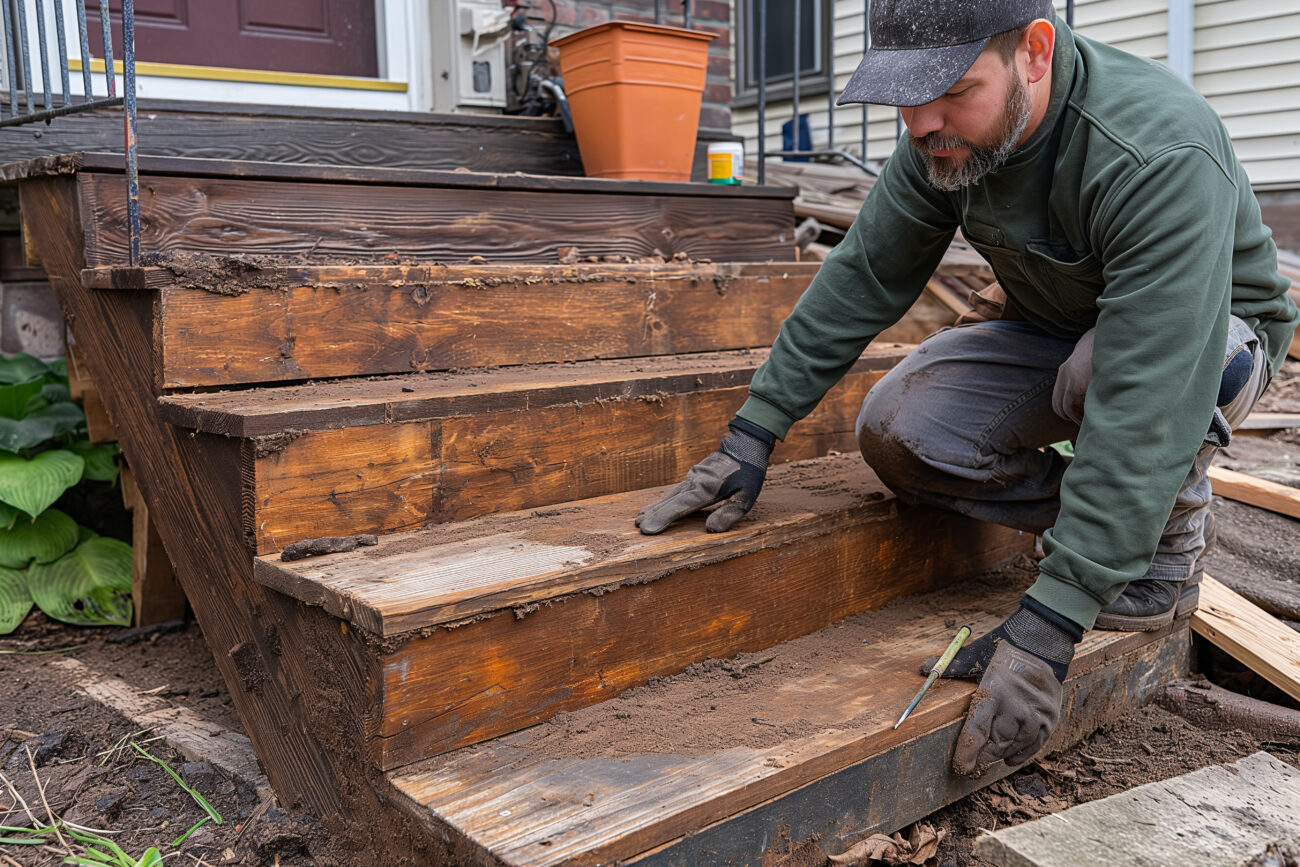
For loose stairs, inspect stringers for rot or cracks and replace any compromised stringer. Re-tread stairs using proper deck screws and ensure riser spacing meets local code for safety. Add blocking between stringers or sister a new stringer to a damaged one when replacement isn’t immediately possible.
Maintaining Deck Integrity
Keep your deck solid by stopping water and pest entry, using durable materials, and inspecting key fasteners and supports on a set schedule. Targeted actions—sealants, stainless fasteners, and quarterly checks—prevent small issues from becoming structural problems.
Preventing Future Damage
Water intrusion and wood decay cause most failures. Re-seal or stain exposed decking every 1–3 years depending on sun and rainfall; apply a water-repellent with mildewcide to horizontal surfaces and the tops of rail posts. Keep planters off bare boards and use risers to allow air flow underneath containers.
Control drainage and ventilation. Ensure gutters direct runoff away from footings, slope deck boards slightly for runoff, and keep at least 18 inches of clearance between soil and joists where possible. Trim vegetation that traps moisture against the deck.
Protect hardware and fasteners. Replace corroded nails with stainless-steel screws and check joist hangers for rust. Tighten loose fasteners and sister any weakened joists to restore load capacity.
Choosing Quality Repair Materials
Match materials to the deck’s exposure and your maintenance tolerance. Use pressure-treated Southern Yellow Pine or rot-resistant species (e.g., cedar, redwood) for structural members; choose capped composite or PVC for low-maintenance walking surfaces where splintering is a concern. For high-traffic boards, pick a wear-rated decking product.
Select corrosion-resistant fasteners and connectors. Choose hot-dip galvanized for treated lumber, or better, 304/316 stainless steel in coastal or high-humidity areas. Use structural-rated joist hangers and bolts, not just nails, at critical connections.
Pick a compatible finish. Use oil-penetrating stains on natural wood, and manufacturer-recommended cleaners and sealers on composites. Keep a single finish type across repairs to avoid adhesion or appearance mismatch.
Best Practices for Regular Inspections
Inspect seasonally: spring, late summer, and before winter. Walk the deck underfoot looking for soft spots, check for sagging or gaps over beams, and probe suspect boards with a screwdriver to detect rot. Record locations and dates in a simple log.
Check hidden components. Inspect ledger connections to the house, flashing integrity, and the condition of posts at the ground or concrete piers. Verify that joist hangers are secure and not pulled away from framing.
Test safety features. Ensure railings are tight by applying lateral pressure at several points. Replace any spindles or balusters with visible cracks or movement. Address small issues within weeks to avoid larger structural repairs.
