Introduction
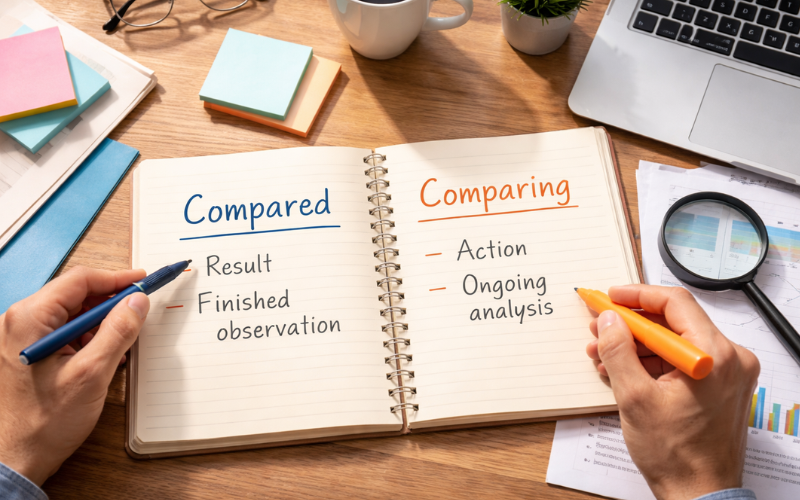
The words compared and comparing both come from the verb compare, but they play different roles in sentences. Because they share the same root and meaning, many English learners mix them up. The confusion usually comes down to one simple idea: one word often shows the result of a comparison, while the other shows the action of making one.
Understanding this difference can make your writing clearer and more natural. It also helps readers follow your ideas without stopping to figure out what you mean. In this article, you’ll learn when to use compared and comparing, how each word changes the focus of a sentence, and how to avoid common mistakes that learners make when using them.
Why “Compared” and “Comparing” Confuse So Many Writers
At first glance, compared and comparing seem almost interchangeable because both relate to examining similarities or differences. In everyday speech, people sometimes use them loosely, which adds to the confusion. However, their grammar roles are not the same.
Compared is usually a past participle. It often describes a state or relationship that already exists. Comparing, on the other hand, is a present participle or gerund, and it highlights the act of analyzing or evaluating something.
Because both words can appear near the start of a sentence or within comparison phrases, writers often assume they work the same way. In reality, context decides which one is correct. The subject of the sentence and the timing of the action both matter. When you understand this, choosing between compared and comparing becomes much easier.
What “Compared” Means in Modern Usage
In modern English, compared usually points to a completed comparison or an established relationship between things. It tells readers that the comparison already exists rather than being actively performed.
You’ll often see compared in sentences that describe how one thing relates to another. For example, when someone says a phone is inexpensive compared to other models, the comparison is presented as a finished observation rather than something the writer is actively doing in that moment.
This word also appears frequently in passive-style constructions. In such cases, the subject is not the one performing the comparison. Instead, it is the object being described. This subtle shift in focus helps the sentence sound more formal or objective, which is why compared often appears in academic or professional writing.
Another common feature of compared is its role in comparison phrases such as “compared to” or “compared with.” In these expressions, the word acts almost like a bridge that links two ideas and highlights their relationship.
What “Comparing” Expresses in a Sentence
While compared points to a finished relationship, comparing shows an active process. It suggests that someone is examining two or more things in order to understand them better.
When writers use comparing, they signal that analysis or reasoning is happening. For instance, if a sentence begins with “Comparing the two reports,” it tells readers that the writer is currently examining them to draw a conclusion. The focus is on the action itself rather than the final result.
This form often appears in introductory participial clauses. These are phrases placed at the beginning of sentences to explain how a conclusion is reached. In such cases, comparing works almost like a spotlight, showing readers the thinking process behind what comes next.
Because it emphasizes activity, comparing can make writing feel more dynamic and analytical. It’s especially useful in essays, reviews, and research writing where explanation and reasoning matter.
How Sentence Focus Changes When You Use Compared vs. Comparing
One of the most important differences between compared and comparing is how they shift the focus of a sentence. Even when the vocabulary around them stays similar, the meaning can change noticeably.
Sentences that use compared usually feel result-focused. They describe what something is like in relation to something else. The comparison is presented as a fact or observation.
Sentences that use comparing feel action-focused. They highlight the process of evaluating information before reaching a conclusion. This makes the tone more analytical and sometimes more personal, because it shows the writer’s reasoning.
This distinction matters across different writing styles. In academic writing, comparing often appears when explaining research methods or reasoning steps. In professional reports, compared is more common when presenting final findings. In casual writing, both forms appear, but choosing the right one still affects clarity and tone.
Compared To vs. Compared With — Where They Fit in the Same Topic
The discussion of compared often leads to another common question: should you use compared to or compared with? Traditionally, the distinction is based on purpose.
Compared to has often been used when likening two different kinds of things, especially when making a metaphor or broad comparison. For example, describing a busy city as calm compared to a storm suggests a poetic or figurative connection.
Compared with, by contrast, has been used when analyzing similar things in a more practical way, such as comparing sales figures from two years.
In modern English, however, the difference is not always strict. Many writers use both expressions interchangeably, especially in everyday contexts. Still, understanding the traditional distinction can help you choose the clearer option in formal writing. Both phrases work closely with the past participle compared, reinforcing its role in describing relationships rather than actions.
Common Mistakes Learners Make With Compared and Comparing
Because compared and comparing often appear at the start of sentences, one frequent problem is misplaced participial phrases. This happens when the phrase does not logically connect to the subject that follows. Readers may struggle to understand who is doing the comparing.
Dangling modifiers are another issue. If a sentence begins with “Comparing the results,” but the subject that follows cannot logically do the comparing, the sentence feels awkward or incorrect.
Learners also sometimes choose the wrong form because they focus only on meaning rather than structure. They might use comparing when they want to describe a finished observation, or use compared when they mean to describe an ongoing analysis. These small choices can make writing sound unnatural even if the vocabulary itself is correct.
Simple Editing Tips to Choose the Right Form Every Time
A quick way to choose between compared and comparing is to ask yourself whether the sentence is describing an action or a result. If the comparison is something being actively performed, comparing is usually correct. If it describes an existing relationship or conclusion, compared is often the better choice.
It also helps to check the subject of your sentence. Ask whether the subject is actually doing the comparing. If not, the participle may be misplaced, and rewriting the sentence could improve clarity.
Finally, reading your sentence aloud can reveal problems quickly. If it sounds like the comparison is unfinished or confusing, try switching the form or restructuring the sentence. Small adjustments can make your writing smoother and easier to understand.
Conclusion
The difference between compared and comparing may seem small, but it plays an important role in clear communication. One word usually describes a completed relationship, while the other highlights the act of analysis. Choosing the right form helps readers understand whether you are presenting a conclusion or explaining a thought process.
FAQs
1. Is “compared” always passive in meaning?
Not always, but it often appears in sentences where the subject is being described rather than actively doing the comparison.
2. Can I use “comparing” at the beginning of a sentence?
Yes, but the subject that follows must logically be the one doing the comparing, or the sentence may sound incorrect.
3. Is there still a strict difference between “compared to” and “compared with”?
In modern English, the distinction is softer than before, but in formal writing, compared with is often preferred for analytical comparisons.
4. Which word is better for academic writing, compared or comparing?
Both are useful. Comparing often appears when explaining reasoning, while compared is common when presenting final observations.
