Introduction
The erlenmeyer flask is one of the most recognizable pieces of laboratory equipment, seen in schools, research labs, and industrial settings around the world. Even people who have never worked in a lab often recognize its slanted sides and narrow neck from textbooks or science illustrations. This simple-looking container exists for a very practical reason: it makes handling liquids safer, easier, and more controlled during experiments. Despite the development of advanced laboratory tools, the erlenmeyer flask remains a standard item because it is reliable, versatile, and easy to use. Its long-lasting popularity shows how a well-designed tool can stay relevant for generations.
What an Erlenmeyer Flask Is and How It’s Defined
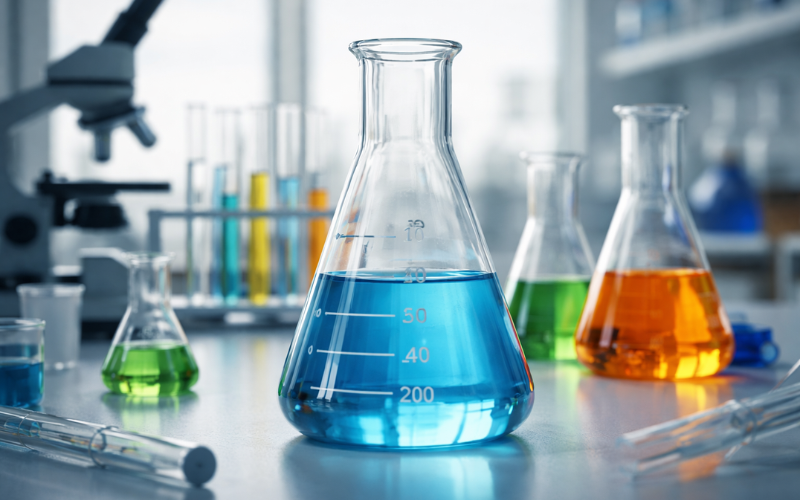
An erlenmeyer flask is a type of laboratory container used mainly for holding and working with liquids. It is defined by its wide, flat bottom, sloping sides, and narrow opening at the top. This design allows liquids to be mixed or heated while reducing the risk of spills. The flask is commonly used in chemistry, biology, and other sciences where liquids need to be handled carefully.
The erlenmeyer flask is not meant to provide extremely precise measurements. Instead, its main purpose is safe and efficient liquid handling. Scientists, students, and technicians rely on it for everyday tasks such as preparing solutions, running reactions, and temporarily storing liquids during experiments.
The Design Features That Make the Erlenmeyer Flask Practical
The shape of the erlenmeyer flask is the key to its usefulness. Its conical body allows liquids to swirl smoothly without splashing out. When the flask is gently moved in a circular motion, the liquid stays inside instead of climbing up the sides and spilling over. This makes it especially useful when mixing chemicals or dissolving solids in liquids.
The narrow neck at the top plays an important role as well. It limits evaporation, reduces exposure to the air, and makes it easier to control pouring. The neck also allows the flask to be covered with a stopper or other closure when needed. Meanwhile, the flat base helps the erlenmeyer flask sit steadily on lab benches or heating surfaces, reducing the risk of tipping over during use.
Common Laboratory Uses of an Erlenmeyer Flask
The erlenmeyer flask is used in many routine laboratory activities. One of its most common uses is mixing liquids. Because the flask can be swirled easily, it allows substances to blend evenly without the need for stirring tools. This is especially helpful when working with chemical reactions that require gentle mixing.
Heating liquids is another common task. The shape of the erlenmeyer flask allows heat to spread more evenly across the liquid, which helps prevent sudden boiling or splashing. It is also widely used for storing liquids for short periods, especially when a temporary container is needed during an experiment. In addition, the erlenmeyer flask is often used to observe reactions, as its clear material allows scientists to see color changes, bubbling, or settling particles.
Materials Used in Erlenmeyer Flasks
Erlenmeyer flasks are commonly made from either glass or plastic, and each material serves a different purpose. Glass erlenmeyer flasks are widely used because they can handle high temperatures and resist many chemicals. They are ideal for heating, chemical reactions, and experiments that require a stable and non-reactive container.
Plastic erlenmeyer flasks are lighter and less likely to break if dropped. They are often used in educational settings or situations where safety is a concern. Plastic versions are also useful for storing liquids that do not require heating. The choice of material depends on the type of experiment, the chemicals involved, and the level of durability needed.
Erlenmeyer Flask Sizes and Volume Range
Erlenmeyer flasks come in a wide range of sizes, from small flasks used for simple tests to large ones used in more complex experiments. Smaller flasks are often used in classrooms or for small-scale reactions, while larger flasks are common in research and industrial labs.
Choosing the right size is important because it affects how easily liquids can be mixed and observed. A flask that is too small may overflow, while one that is too large may make measurements less convenient. Although erlenmeyer flasks often have volume markings, these markings are approximate. They are useful for general guidance but not for precise measurement.
How the Erlenmeyer Flask Compares to Other Lab Flasks
Compared to other laboratory flasks, the erlenmeyer flask stands out because of its balance between stability and ease of use. Unlike round-bottom flasks, it can stand on its own without special supports. Compared to straight-sided containers, its sloped sides make swirling much easier and safer.
While some flasks are designed for very specific tasks, the erlenmeyer flask is a general-purpose tool. This versatility is why it is often the first choice for many laboratory procedures. It may not replace specialized equipment, but it complements other lab tools by handling a wide range of everyday tasks efficiently.
Safe Handling and Proper Care of an Erlenmeyer Flask
Proper handling of an erlenmeyer flask helps ensure safety and long-term use. When working with glass flasks, care should be taken to avoid sudden temperature changes, as these can cause cracking. Always place the flask on a stable surface and handle it with clean, dry hands to prevent slipping.
Cleaning is also important. Residue left inside the flask can affect future experiments. Most erlenmeyer flasks are easy to clean with warm water and mild cleaning solutions. After washing, they should be allowed to dry completely before storage. Storing flasks in a clean, dry place helps prevent damage and contamination.
Educational and Professional Importance of the Erlenmeyer Flask
The erlenmeyer flask plays an important role in education. It is often one of the first pieces of laboratory equipment students learn to use. Its simple design helps beginners understand basic laboratory techniques such as mixing, heating, and observing reactions.
In professional environments, the erlenmeyer flask remains just as important. Researchers, technicians, and industrial workers rely on it for routine tasks that require reliability and ease of handling. Its continued use across different fields highlights its value as a dependable and practical laboratory tool.
Conclusion
The erlenmeyer flask may appear simple, but its thoughtful design has made it an essential part of laboratory work for generations. From classrooms to advanced research labs, it supports safe mixing, heating, and handling of liquids in a way few other containers can. Its versatility, durability, and ease of use explain why it remains a standard piece of equipment today. The lasting importance of the erlenmeyer flask shows that even the simplest tools can have a powerful impact on how experiments are done.
FAQs
1. What is an Erlenmeyer flask mainly used for?
An Erlenmeyer flask is mainly used for holding, mixing, heating, and temporarily storing liquids in laboratory experiments. Its sloped sides and narrow neck make it safer for swirling liquids without spilling.
2. Can an Erlenmeyer flask be used for precise measurements?
No, an Erlenmeyer flask is not designed for precise volume measurements. While it has approximate markings, accurate measurements should be done using tools like graduated cylinders or volumetric flasks.
3. Why does an Erlenmeyer flask have a conical shape?
The conical shape allows liquids to be mixed easily by swirling while reducing the risk of splashing. It also helps control evaporation and makes the flask more stable during heating or handling.
4. What materials are Erlenmeyer flasks made from?
Erlenmeyer flasks are commonly made from glass or plastic. Glass flasks are preferred for heating and chemical reactions, while plastic flasks are lighter, safer to handle, and suitable for non-heated applications.
